
Dakotas Leaders explore new ways of being church at Fresh Expressions Gathering

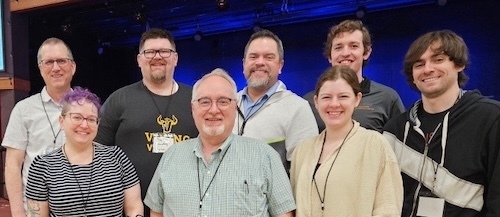
Attendees were, front, l-r, Conference Connector Bri Heida, Rev. Dan Bader, Conference Connector Meaghan Wharton, Rev. Jordan Loucks, back row, Revs. Mark Ehrmantraut, Clay Lundberg, Jef Lathrop, and Bryce Blank. (Photos by Rev. Clay Lundberg)
Eight leaders from the Dakotas Conference recently joined nearly 500 church leaders from across the country in Ocala, Florida, to explore new ways of connecting people with Jesus and building communities of faith.
The gathering focused on the growing movement known as Fresh Expressions within The United Methodist Church—an approach that encourages churches to form new communities of faith that complement—not replace—traditional congregations. These communities often begin outside church buildings in places such as coffee shops, homes, parks, restaurants, or other community gathering spaces. Through listening, relationship-building, and shared experiences, these ministries create natural opportunities to introduce people to the love of Jesus.
The Dakotas group included two conference connectors, five pastors, and one district superintendent. Through worship, workshops, conversations, and visits to local ministries, participants explored how churches can listen more deeply to their communities and experiment with new forms of ministry.
For Bri Heida, connector for renewal in the Dakotas Conference, the experience was both energizing and hopeful.
“It was incredibly encouraging to be amongst 500 gathered to think, talk, imagine, and dream about breathing new life into our churches,” Heida said. “The entire event was about shattering our expectations and making room for God to do a new thing—from the worship to the speakers to the immersions.”
Heida said the gathering challenged participants to rethink long-held assumptions about how church should look and function.
“Our inherited ideas were turned upside down, and we were invited to ask new questions– to wonder ‘what if?’” she said. “It was thrilling to find other folks who are feeling the same call to renewal I am, to enter into conversations about where we see God on the move already and where we can step into that work alongside the Spirit.”
A Movement Rooted in Methodist DNA
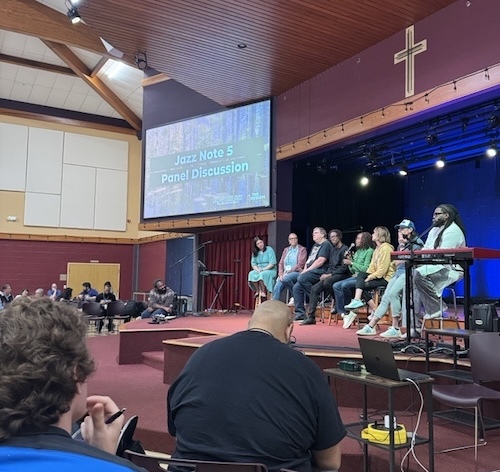
Fresh Expressions encourages churches to create new communities of faith outside traditional church settings—often meeting in homes, restaurants, parks, or other community spaces. These ministries typically begin with listening and relationship-building rather than programs.
For Heida, the movement feels deeply connected to the roots of Methodism.
“Fresh Expressions are the most Methodist thing we could be doing in our churches right now,” she said. “To help our parishioners cultivate rich inner lives, to give them permission to engage their imaginations, and to empower them with a sense of spiritual agency—that was exactly what Wesley was up to 300 years ago.”
She added that the model allows clergy to equip and empower laypeople to lead ministry in their own communities.
“The Fresh Expressions model gives our laity the opportunity to take a participatory role in building the Kingdom of God while drawing on their own experience, passions, talents, and understanding,” Heida said. “That means the gospel gets to move into the neighborhoods around us, and those folks who aren’t coming to our churches get to encounter the love of God in real, meaningful ways.”
Listening Before Acting
Many of the conversations at the gathering emphasized that Fresh Expressions do not begin with a clever idea or program. Instead, they start with listening.
Rev. Jeff Lathrop said that lesson stood out clearly during the event.
“One panelist said that we—in general, but especially as the church—need to stop assuming that what we have to offer is what is actually needed or wanted,” Lathrop said. “We assume we understand the need and already have the solution without actually listening to or asking those whom we would like to reach.”
For Lathrop, the insight echoed a foundational principle of ministry.
“No one cares what you know until they know that you care,” he said. “Ministry should be relational. That’s how growth and engagement happen.”
For Rev. Clay Lundberg, pastor of Zion United Methodist Church in Grand Forks, North Dakota, the reminder of the importance of listening first was a call to action— to begin with conversations in his own community.
“I am going to be having further conversations with the principal of the elementary school near Zion and the social worker associated with that school to hear their opinions about the needs of the community,” he said. “Based on what we already know, it is likely that some kind of dinner church may be on its way to our neighborhood.”
Church Around the Table
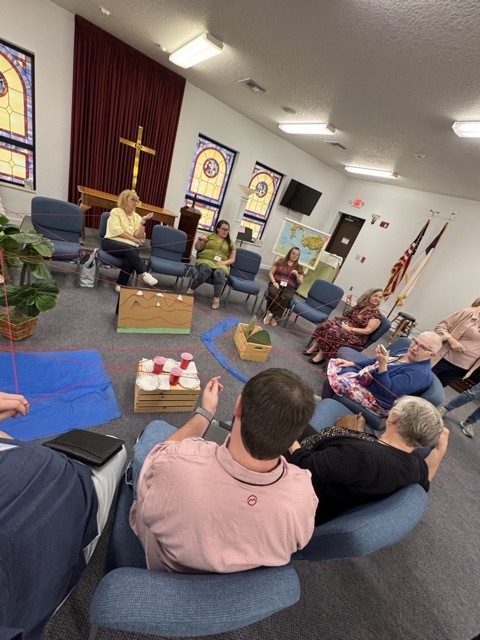
Another memorable experience for Lundberg was visiting Ocala West UMC’s “Brunch and Play,” a monthly gathering designed for families who may not be connected to a church.
The morning began with families sharing simple activities—building with LEGO®, playing board games, coloring, or shaping Play-Doh—before sharing a meal together. After brunch, participants moved to the chapel for an interactive lesson, craft, and game.
Each month, the church opens its doors to families from the community, many of whom had never been connected to a congregation before.
“One of the stories Pastor Jen shared with us is that two youth who came to Brunch & Play had asked about baptism,” Lundberg said. “While they were talking about baptism, two of their adult volunteers revealed that they had never been baptized, so all four of them were baptized together.”
The experience demonstrated how simple acts of hospitality can open doors to discipleship and transformation.
Empowering the Church for a New Season
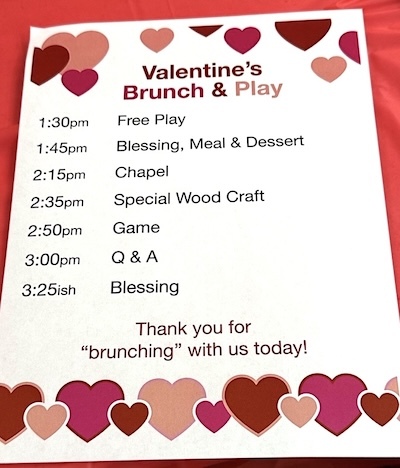
The Brunch and Play schedule.
Heida said one of the most significant insights from the gathering is that the church is living in a time of transition.
“One of the biggest realizations I had at this event was that we are in the midst of a major transition as a people trying to be faithful Methodists,” she said. “We are fermenting the new wine, and we have to craft new wineskins to hold it.”
She believes this moment calls for new questions and new ways of measuring faithfulness.
“We are awakening to deeper truths about who we are called to be,” Heida said. “But we are still bringing the old questions to the new paradigms we’re receiving. Our call in this moment is to come up with new, better questions.”
That shift includes encouraging experimentation and empowering both clergy and laity to try new approaches to ministry.
“At the church level, we need simple but powerful teaching to shift the culture to one of permission, experimentation, and empowerment of laity,” Heida said. “At the conference level, we need to encourage this culture shift and resource our clergy and laity to lead through change.”
Reclaiming the Church as a Movement
Lathrop believes Fresh Expressions invites the church to rediscover its identity as a movement rather than an institution.
“Churches should consider a Fresh Expression-type ministry because that’s the history of not just our denomination but the early church,” he said. “The early church was on the move and met in various places. Jesus went where the people were.”
He also pointed again to Wesley’s example.
“John Wesley dared to reach people outside of the church and preach beyond the pulpit,” Lathrop said. “We need to recapture our roots and history as a movement rather than a stagnant or stuck people without much imagination.”
Addressing Real Needs
Rev. Mark Ehrmantraut, pastor of Calvary UMC in Bismarck, North Dakota, also found encouragement in the gathering’s focus on authentic relationships.
“Leaders, presenters, and attendees were all there with one purpose in mind,” Ehrmantraut said. “At the core, we all wanted to continue to grow in connecting with people we might not otherwise reach.”
One workshop that stood out to him was the “Loneliness Café,” which addressed the growing epidemic of loneliness in modern society.
“The data around loneliness in our culture is very concerning,” Ehrmantraut said. “The Christian faith, when faithfully experienced, helps to push back against the loneliness epidemic.”
Inspired by the gathering, Ehrmantraut’s congregation is beginning to pray and explore possibilities for a dinner church and other community-based ministries.
“Plain and simple,” he said, “there are too many people we are not going to connect with if we don’t experiment with Fresh Expressions.”
Pastor Jordan Louks, who serves Faith United Methodist Church in Fargo, North Dakota, felt the relational aspect of Fresh Expressions as well.
"Fresh Expressions ministry is relational evangelism. It is connecting with people where they are at," said Louks. "People are longing for connection and community. People are longing for hope."
"With God's help, we can be ambassadors of that in our community through creating new expressions of church that may look different than the past but still connect people with God and community," he added. "It might just be at a board game night, a walk along the river, or at a restaurant. And God's already there anyway."
In a time when many people view the church as irrelevant or disconnected, Lathrop believes experimentation is essential.
“There are some exciting opportunities out there if only we are ready to try them,” he said.
For the Dakotas leaders who attended the gathering, the experience offered encouragement, inspiration, and a renewed sense of possibility.
"This conference reignited for me why I went into ministry. Helping people find connection and belonging is super important for me," said Louks. "I can remember how important it was in my life to know that God was there for me and people were there for me, too. And that happened outside the walls of the church. So, I think it helped reignite that spark."
As churches across the Dakotas Conference seek to share the gospel in a changing world, Fresh Expressions offers a reminder that ministry has always required creativity, courage, and a willingness to meet people where they are.